This painting by Charles M. Russell explores the forced relocation of Native American Indians during American expansion westward. The fact that the native American peoples are being overpowered in this image by the landscape their moving away from, can be interpreted as a means of an end, the end of their home and their lifestyle in the west. The fact that expansion is literally pushing them, is an example of the force and ruthless determination of the settlers.
This picture shows how America will continue to expand because it has developed in the East and now it is moving West and will probably start to create towns and cities too. I particularly like how in the distance there are cities and its faded so is thought of as old and the fields are almost yellowy gold so they seem new and rich to invest in which would of attracted a lot of peoples attention.
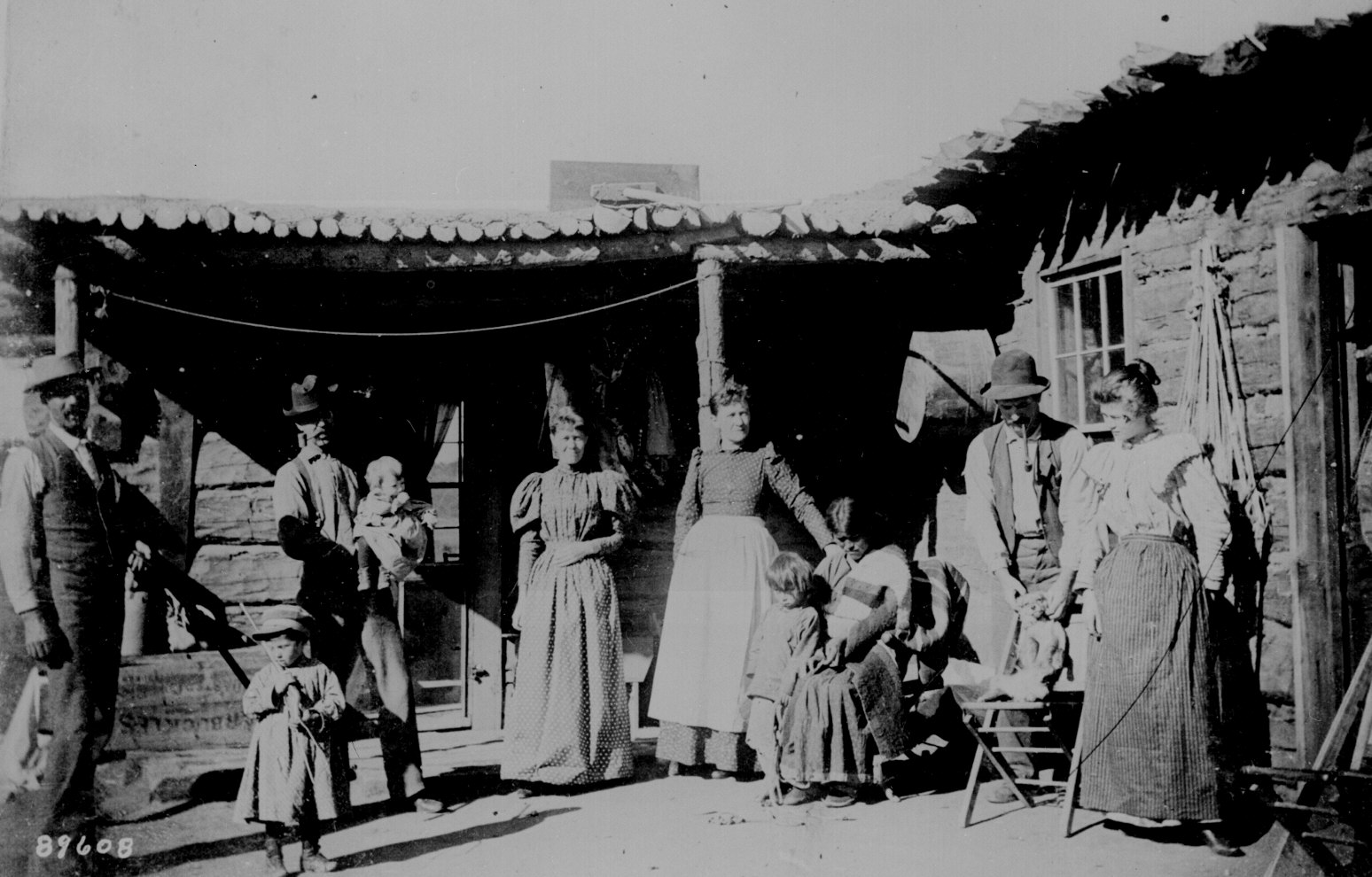
This picture I found has significant features as it is a demonstration of the relationship between the white settlers. The description of the picture that is given is "A family group poses with dog, Indian domestic, and young children outside a log cabin in New Mexico Territory, ca. 1895." I think the title itself shows the dismissal of the status of the native Americans as they are seen to be, in this picture, on a par with the dog and the young children, which is particularly interesting.
Also the physical act we see of the woman putting her hand to almost hold down the native American demonstrates the power that the settlers had over the natives. It's as though she is metaphorically and physically holding down the native and will not let her stand so she can be free to move where she wants. The dog too has hands that on it but it looks more a sign of affection rather than a metaphorical symbol of oppression.
Also the Native American has her head facing the ground. It looks like a sign of submission and loss of hope, as she no longer has the will power to raise her head. The white settlers look more confident which is reflected in their stance and the way they look, almost menacingly, into the camera.
As the people of America moved westwards in exploration for land and wealth, nothing was gonna stop them and get in there way. The men leading the frontier were ruthless and persistent especially with the Native Americans, who were either forced to move on westwards running for their lives or they were simply killed on the spot.
The picture I have chosen by Remington: Indian Warfare (1908)is a prime of example of the movement. The setting you can tell is in the West with the open grass land plains, where you have no natural or man made structure as far as the eye can see. In the foreground you have the stereotypical image of Native Americans, riding horses firing rifles - how factual this is to be decided as before the English came Native Americans didn't ride horses as dictated in this painting - but nevertheless you can see the panic and confusion amongst then as they are fleeing while being shot at by the Americans. In a way it can been seen that Remington is showing this movement from the Native American point of view as it is said that, 'His focus was firmly on the people and animals of the West'. Just by showing a view point like this you get a better understanding as the viewer of this painting to how the Natives may have felt. Fear. Panic. Confusion some of the many emotions shown on their faces.
The American people, that you can see in the background, out numbered the Natives, were more skillful than the natives, out gunned the Natives which all contributed them to being more powerful then the natives. American people explored the west saw the land to free and open, not owned by anyone and there for it was there 'God given gift' to take and have which is why they were so ruthless as they saw it as their right to have it. In a way it can be seen that by the moving on and killings of Native Americans it was as a form of pest control as they were unwanted and not seen a part of the new image forward for America.
The Bill Blanton advertisement campaign from 1992immediately examines the of Bill Clinton to create an understanding between him and the listeners.
He seems thankful of any type of meeting with the former US president, Kennedy. This makes him seem humble and human. He says that small meeting was enough for him to be inspired to become the next US president.
He claims that his humble roots stayed with him even with his political popularity grew as he says that all he wanted to do was help people. He only mentions his policies which are to promote education, healthcare and to create jobs that will supposedly make "real progress".
He claims that he wants to bring hope back to the American dream.
In other words he wants to be the inspiration that Kennedy was to him and that anything is possible.
George W. Bush was the President of the USA from 2001 to 2009. This is one of his campaign ads from 2000, where he mentions his beliefs towards government. He begins by by expressing that he feels people should be held accountable for their actions. Already this gives the voter a sense that he is a believer in justice, a key element in American ideology. He goes on to say, "I believe in a government that is responsible to the people". This directly links to one of the greatest historical American quotes from Lincoln at the Gettysburg Address "that government of the people, by the people, for the people, shall not perish from the earth." Here by creating a link to Lincoln, he gets the voter to feel that he too can be a great president, as he shares ideas. He goes to to talk about 'trust', acknowledging that ultimately his fate is in the hands of the voter, and that he trusts them to do the right thing, and that in response he will trust them to aid his decision making. "We should help people live their lives, not run them" is the last point made in this ad, which gives the impression of freedom without censorship and the ability to choose how to live your life, which perhaps is not in fact the case. Bush strongly plays on the key ideology of freedom and justice in his campaign ad, with ideas which can be related back to Lincoln or the declaration of independence. In his re-election campaign in 2004, Bush plays strongly on the idea of defence and national fear after the 9/11 attacks. He talks about his opponent wanting to slash defence and intelligence budgets by $6 billion, which would weaken American defences and therefore cause harm to America. This clearly worked as he was elected again in 2005.
This
is a political campaign for Barack Obama
- but not the stereotypical. The advert for his campaign doesn’t say what he
will do if he is elected as President, but it says what his Republican opponent
Mitt Romney won’t
do, claiming that he is giving at false hope and belief.
The President of the U.S is
meant to be there to represent the people of the country, in a way the voice of
the people similar to that of Senator and Member of Congress, but this Ad by
the Democratic Party claims that Mitt Romney
isn’t. It highlights how he has meant to have favoured one specific level
of the class system- the rich which is
a minority – and left behind the ‘middle class’ raising their taxes and
ignoring them and in a way claiming that he will not be a strong representative
of them.
Another point that is made is
how “He out sourced Jobs to India”. There is currently and always has been this
urge that the U.S should be an independent nation on not have to rely on that
much on others.By Romney apparently sourcing jobs outside he isn’t sticking to U.S
beliefs as he should be helping boost the jobs on the home front and therefore
failed his country.
It is because of all these
promises being made and then followed by failures that help this Ad so well and
as the Ad says, “It didn’t work then. It won’t work now”